Household Hazardous Waste Disposal in Bucks County, PA
Written by: Sal, The Longship Crew · Levittown, PA
Last updated: 10 min read
Table of Contents
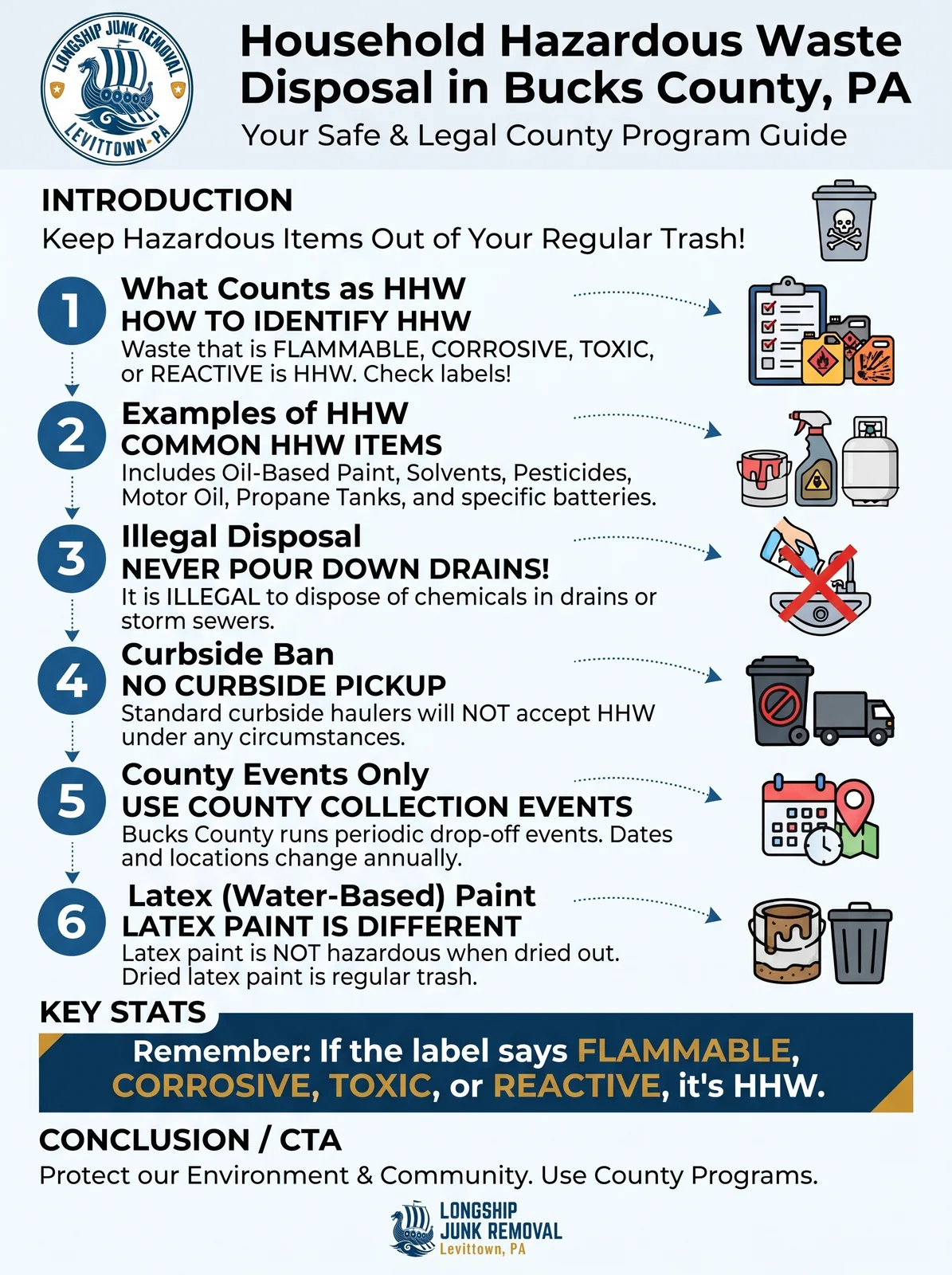
Bucks County residents dispose of household hazardous waste (HHW) at scheduled county collection events — not through curbside trash pickup and not through a junk-removal crew. HHW covers items like oil-based paint, solvents, pesticides, motor oil, propane tanks, and certain batteries. The safe, legal route for all of it is the county’s dedicated collection program, not the regular garbage can.
Here’s what matters before you load up your car:
Curbside haulers and standard trash service will not accept HHW under any circumstances.
Latex (water-based) paint is not hazardous waste once dried out — it’s one of the most common mix-ups.
Bucks County runs periodic drop-off events rather than a permanent daily HHW facility, so dates and locations change year to year.
Electronics, appliances, and tires are banned from curbside trash too, but they follow different disposal channels than HHW.
Pouring chemicals down a drain or storm sewer is illegal, not just discouraged.
What Counts as Household Hazardous Waste
Household hazardous waste is any leftover household product that’s flammable, corrosive, toxic, or reactive enough to harm people, sanitation workers, or the environment if it ends up in regular trash. A simple rule: if the label reads “flammable,” “corrosive,” “toxic,” or “reactive,” treat it as HHW and route it accordingly.
The categories a typical Bucks County homeowner runs into most often include:
Oil-based paints, stains, solvents, and thinners — these remain wet and combustible indefinitely and can’t be legally dried out for curbside disposal.
Automotive fluids — motor oil, antifreeze, and gasoline contaminate soil and groundwater if dumped or tossed in regular trash.
Pesticides, herbicides, and pool chemicals — concentrated formulas that are toxic to people, pets, and waterways.
Household cleaners and pool acids — many are corrosive and shouldn’t be mixed with other trash or chemicals.
Propane tanks and other flammables — pressurized containers pose fire and explosion risks in a garbage truck.
Certain batteries — rechargeable and lithium batteries can spark fires when crushed or punctured.
Mercury-containing items — old thermostats and thermometers release toxic vapor if broken.
Items People Wrongly Assume Are HHW
Not everything that sounds hazardous actually is. Latex or water-based paint is not household hazardous waste — once it’s fully dried out (leave the lid off, or mix in cat litter or a commercial paint hardener to speed it up), it can go in your regular trash. Oil-based paint is the opposite case and does need an HHW event.
Electronics and appliances cause confusion too. TVs, monitors, and computers are banned from curbside trash under Pennsylvania law, but they’re handled through e-waste recycling channels, not the county HHW program. Old refrigerators and other Freon-containing appliances need certified refrigerant handling — again, a separate process from HHW drop-off.
Bucks County HHW Collection Events: How the Program Works
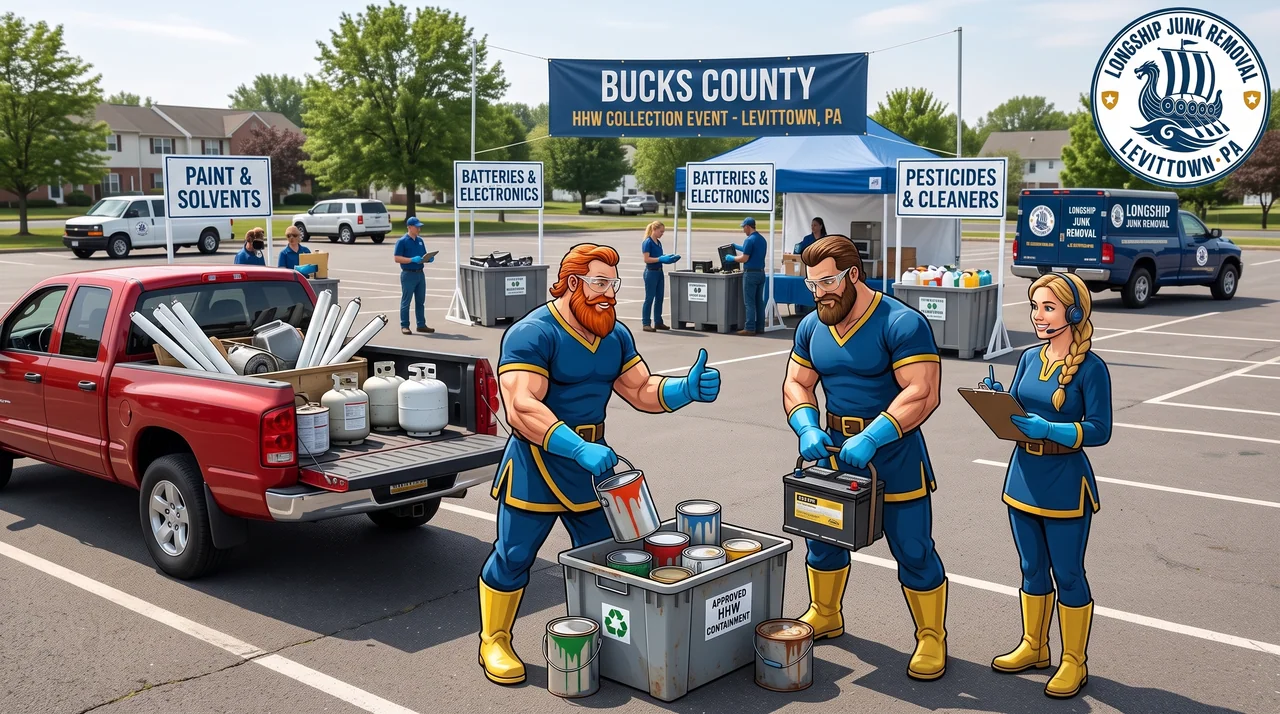
Bucks County manages household hazardous waste through periodic collection events rather than a permanent walk-in facility. These events are typically scheduled on Saturdays at designated sites throughout the year, and they’re free for Bucks County residents. Proof of residency may be required at check-in, so bring an ID or a piece of mail with your address. Confirm current registration requirements and any per-household quantity limits before you go — these change from year to year.
Because the program is event-based rather than daily, planning ahead matters more than it would with a standard transfer station. Showing up on a random weekend without confirming the schedule is the single most common mistake residents make.
Where and When Events Are Held
Locations and dates rotate and are announced annually on the official Bucks County website. Before you load your trunk, confirm three things directly with the county’s current listing: the exact date, the site address, and the operating hours. Confirm the current schedule and site locations directly with Bucks County before planning your trip. Specific dates aren’t listed here because they change from year to year.
What to Bring and How to Prepare Your Materials
A little prep at home makes the drop-off faster and safer for everyone in line behind you. Follow these steps:
Keep each product in its original, labeled container whenever possible — unlabeled chemicals are harder for staff to process and may be rejected.
Never mix different chemicals together in one container, even if they seem similar.
Pack containers upright in a sturdy box or crate so nothing tips or leaks during transport.
Transport materials in your trunk or truck bed, away from passengers, and keep the area ventilated.
Stay in your vehicle at the drop-off site — trained staff will unload your materials for you.
Most programs also cap the quantity accepted per household in a single visit. Check current quantity limits with Bucks County before bringing a large volume of material.
What You Can’t Bring to an HHW Event
HHW collection events are built for typical household quantities of common hazardous products — not every category of waste. Items usually excluded include:
Explosives, fireworks, and ammunition
Radioactive materials
Medical, biohazard, or sharps waste
Large-volume commercial or business waste
Latex paint (not hazardous once dried — goes in regular trash)
Electronics, tires, and appliances (handled through separate recycling channels)
Check the full exclusion list for the current program year on the Bucks County site — accepted categories shift.
How to Dispose of Specific Hazardous Items in Bucks County
Once you know an item counts as HHW, the next question is simple: which channel handles it? Here’s the breakdown for the items homeowners deal with most.
Paint (Latex vs. Oil-Based)
This is the single most common HHW question, and the fix is straightforward. Latex or water-based paint isn’t hazardous waste — remove the lid, let it air-dry completely (or speed things up with cat litter or a paint hardener), and toss the dried can in regular trash. Oil-based paint, stain, and varnish stay flammable indefinitely and must go to an HHW collection event.
Motor Oil, Antifreeze, and Automotive Fluids
Used motor oil is widely accepted for recycling at many auto parts stores and service centers — call ahead to confirm a specific location takes it. Call ahead to confirm a specific retailer accepts it before making the trip. Antifreeze and other automotive fluids should go to an HHW event or a facility specifically set up to recycle them. Never pour any of these down a drain, into a storm sewer, or onto the ground.
Propane Tanks and Flammables
Grill-size propane tanks and larger cylinders belong at an HHW event or a tank exchange/return program — never in curbside trash, and never handed to a junk-removal crew. A pressurized, partially full tank is a genuine fire and explosion risk in a collection truck, which is exactly why these programs exist.
Pesticides, Herbicides, and Pool Chemicals
Keep these in their original containers and route them to an HHW event. Never pour leftover pesticide, herbicide, or pool chemical down a drain or storm sewer — these products are designed to kill living organisms, and that includes the aquatic life in local waterways.
Batteries and Electronics
Not all batteries are handled the same way. Single-use alkaline batteries can typically go in regular trash in small numbers, while rechargeable and lithium batteries pose a fire risk and should go through a retailer take-back program or dedicated battery recycling drop-off. Car batteries are almost always accepted back at the point of purchase.
Electronics — TVs, monitors, computers, and printers — are banned from Pennsylvania curbside trash entirely and don’t belong at an HHW event either. They need a certified e-waste recycler. Check current Bucks County e-waste drop-off options — that program runs separately from HHW collection.
Why You Can’t Put Hazardous Waste in Curbside Trash
Curbside haulers in Bucks County simply won’t take HHW, and that’s not an inconvenience — it’s the law. These materials contaminate landfills, expose sanitation workers to chemical hazards during collection, and can leach into soil and groundwater long after they’re buried. A cracked container of solvent or pesticide in a garbage truck compactor is also a real safety hazard for the crew.
Dumping chemicals down a drain or storm sewer is illegal for the same underlying reason: storm sewers typically flow straight to local creeks and eventually into the Delaware River watershed, with no treatment in between. Proper HHW disposal isn’t just responsible housekeeping — it’s a legal obligation every Bucks County resident is expected to follow.
Where Household Hazardous Waste Fits with Junk Removal
It helps to know exactly where the line sits between what a junk-removal crew can haul and what has to go through the county’s HHW program. A full-service junk removal team clears out furniture, appliances, electronics, and general clutter — but by law, that same crew cannot legally transport paint, solvents, chemicals, pesticides, propane tanks, or other flammable and hazardous materials, along with medical or biohazard waste.
Freon-containing appliances and e-waste sit in a different category. Those items are legitimately handled by a junk-removal crew that follows proper procedures, since they require certified handling rather than county HHW drop-off. If you’re clearing a garage, basement, or full estate and you’re not sure which pile goes where, sorting it out ahead of time saves a wasted trip in either direction.
Longship Junk Removal of Levittown clears out garages, basements, attics, and full estates across Levittown and Lower Bucks County, and handles Freon appliances and e-waste the right way — while pointing customers to the county’s HHW events for anything the crew legally can’t take. One upfront price, no surprise fees, and a crew that’s been sorting through Lower Bucks homes for 15+ years.
Sorting a cleanout and not sure what stays, what goes to HHW, and what the crew can haul? Call (267) 609-9327 for a free upfront quote on your Levittown garage, basement, or estate cleanout.
Household Hazardous Waste at a Glance
Here’s a quick reference for where common items actually belong:
Item
Curbside Trash
HHW Event
Junk Removal Crew
Latex/water-based paint (dried)
Yes
No
Yes, if leftover clutter
Oil-based paint, solvents
No
Yes
No
Motor oil, antifreeze
No
Yes (or auto retailer)
No
Propane tanks
No
Yes
No
Pesticides, pool chemicals
No
Yes
No
Rechargeable/lithium batteries
No
Often via retailer drop-off
No
TVs, computers, e-waste
No
No
Yes, via certified recycler
Freon appliances (fridges, freezers)
No
No
Yes, with proper handling
Furniture, general clutter
Limited
No
Yes
Frequently Asked Questions
Is household hazardous waste disposal free in Bucks County?
HHW collection events are generally free for Bucks County residents, though proof of residency may be required at check-in. Per-household quantity limits may also apply. Confirm current details on the official Bucks County site before you go.
Can I put paint in my regular trash in Bucks County?
Latex or water-based paint can go in regular trash once it’s fully dried out, with the lid removed so collectors can see it’s solid. Oil-based paint stays flammable and must be taken to an HHW collection event instead.
Where do I take old electronics and TVs in Bucks County?
Electronics are banned from Pennsylvania curbside trash and aren’t accepted at HHW events either. They need a certified e-waste recycler or the county’s designated e-waste program. A junk-removal crew can also take electronics as part of a cleanout.
How do I get rid of a propane tank in Bucks County?
Grill-size and larger propane tanks should go to an HHW collection event or a tank exchange/return program. Never place a propane tank in curbside trash, and don’t expect a junk-removal crew to haul one — it’s a fire and explosion risk they’re not permitted to transport.
Can a junk removal company take hazardous waste?
No. By law, junk-removal crews cannot transport household hazardous waste like paint, chemicals, oils, propane, or biohazard materials. They can take furniture, general clutter, appliances (including Freon units), and e-waste. True HHW has to go through a Bucks County collection event.
When is the next Bucks County HHW collection event?
Dates and locations are set annually and published on the official Bucks County website. Check there for the current schedule before you plan a trip, since sites and hours change from year to year.
Once you know what’s true HHW and what isn’t, the rest of a cleanout gets a lot simpler. Sort the hazardous items aside for the county’s next collection event, and let a full-service crew handle everything else — furniture, appliances, e-waste, and the general clutter that’s actually safe to load onto a truck. Visit Longship Junk Removal of Levittown to get a free upfront quote on the rest of the job.
Sal is the voice of the Longship crew — 15+ years clearing garages, basements, attics, and whole estates across Levittown and Lower Bucks County. His rule: you get one upfront price before anything moves, and that price is the most you pay. He writes here about what the crew actually meets inside Levittown homes, and what a job really costs. Sal is Longship's illustrated crew character — the brand's voice, not a staff member.