Sell Your Old Motorcycle: Why a Free Quote Starts With Year, Make, and Model
Written by: Sal, The Longship Crew · Levittown, PA
Last updated: 9 min read
Table of Contents
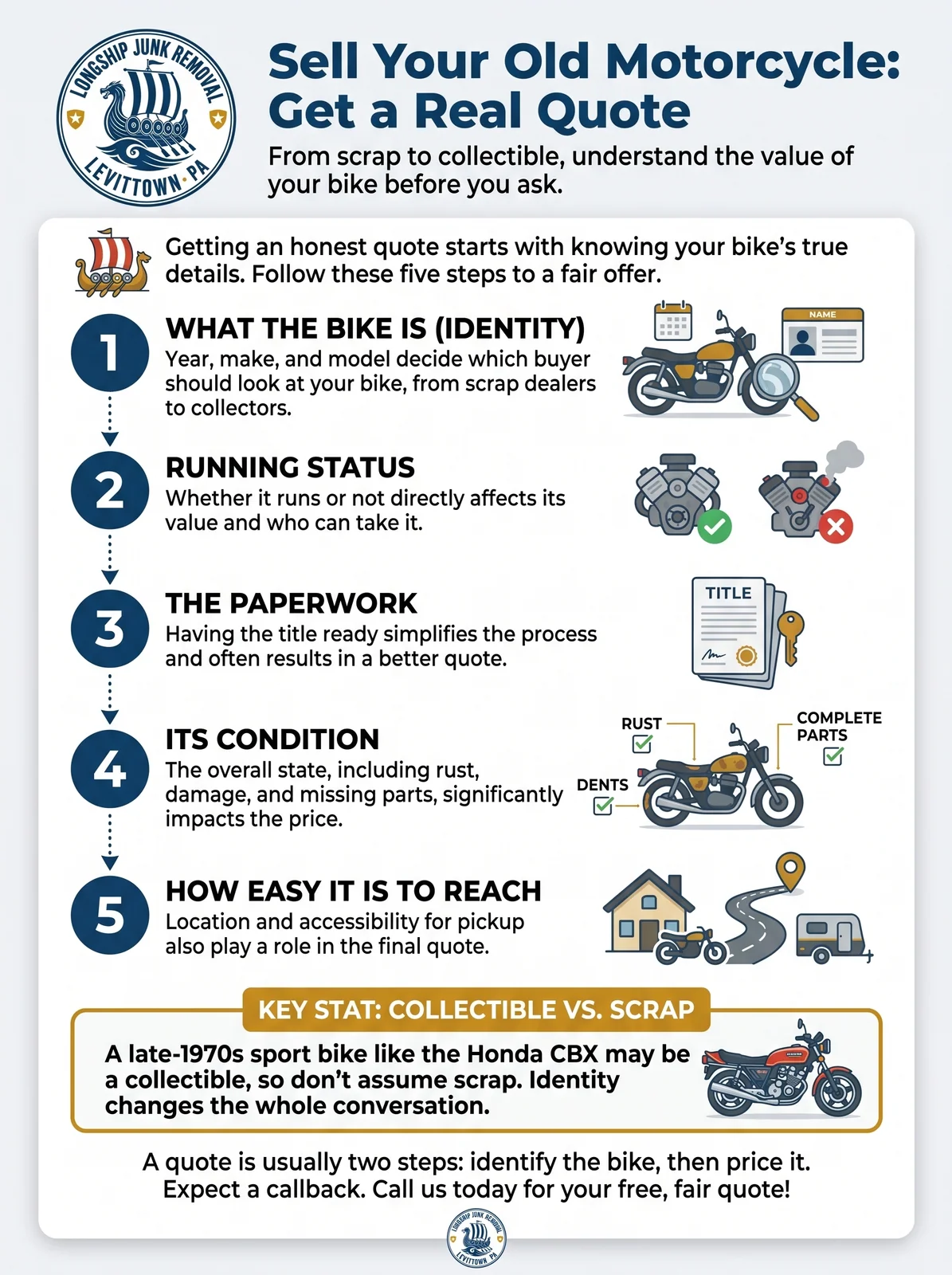
If you want to sell your old motorcycle or just get it gone, any honest quote starts with what the bike actually is: year, make, and model. Then come whether it runs, whether you hold the title, and where it sits. ‘Old’ covers everything from scrap to collectible, and this guide helps you sort yours.
What to know before you ask for a quote
Year, make, and model decide which kind of buyer should look at your bike.
Running status, title, condition, and location move the number after that.
A late-1970s sport bike like the Honda CBX may be a collectible, so don’t assume scrap.
A quote is usually two steps: identify the bike, then price it. Expect a callback.
What a Free Quote on an Old Motorcycle Really Depends On
A quote on an old motorcycle rests on five things, in this order: what the bike is, whether it runs, the paperwork, its condition, and how easy it is to reach. Identity comes first because it decides who should even be looking at the bike.
Why year, make, and model come first
Picture a weekend call. The caller says she wants to get rid of an old motorcycle. She doesn’t say sell, scrap, or haul away. After her name and a callback number, the first thing asked is year, make, and model. Her answer: a 1979 Honda CBX, which she calls a super sport.
That one answer changes the whole conversation. The CBX is a six-cylinder Honda from the late 1970s, a model collectors know by name, so it could deserve a specialist’s attention where a generic old bike would get a flat scrap offer. Nobody on that call could responsibly say a number yet.
We won’t put a dollar value on a CBX here. Recent sold listings and a specialist’s eye do that job better than any article.
The other details that move the number
Once the bike is identified, these facts tighten the quote:
Running or not. A bike that starts and rides is a different product from a seized engine.
Title in hand. Paperwork changes who can legally buy it and how much they’ll pay.
Condition and originality. Rust, repaints, and aftermarket swaps all count, and for classics, original parts count most.
Missing pieces. A gone tank, exhaust, or seat shrinks the offer.
Location and access. A bike on a garage floor is easy. One in a basement behind a staircase is not.
The caller above gave none of these on the first call, which is normal. It’s also why the follow-up quote needs them. Honest pricing takes two passes, and the second pass is where the real number shows up.
Is Your Old Bike Junk, a Parts Bike, or a Collectible?
Sort the bike by demand, not by age. Plenty of old bikes nobody wants to ride are still wanted, either for their pieces or as a whole machine.
Collectibles and classics: the CBX example
Some older bikes are sought after even when they don’t run. A late-1970s Honda six-cylinder is the kind of model that falls in that bucket. Before you accept any scrap-style offer, look up recent sold listings for the same model in similar condition, and talk to a classic-bike specialist or auction house.
Nothing here promises a price. But a buyer who never asks which model you own isn’t pricing your bike. Walk away from that offer.
Parts bikes and non-runners
A seized engine, a wrecked frame, or a bike with no title can still have value in pieces. Engines, wheels, gas tanks, and instrument clusters are what parts buyers look for.
Photos do the selling. Send both sides, the engine, the tank, the frame number plate, and a clear shot of any damage. A buyer who can see the parts can quote the parts.
True scrap
Rusted through, stripped, no title, and no one asking about it. That’s scrap, and removal or a scrap yard is the realistic route. A scrap yard pays for metal, so expect a modest check or none. Here the goal is simply getting it out of your garage.
Your Options for Selling or Getting Rid of an Old Motorcycle
‘Get rid of’ and ‘sell’ lead to different places. Here is how the main routes compare.
Route
Best for
Effort on your end
What to expect on payment
Private sale
A running bike with a title and good photos
High: listings, messages, meetups, paperwork
You set the price and get paid at handoff
Dealer or consignment
Runners when you don’t want to deal with buyers
Medium
Dealers offer less; consignment pays after the sale
Specialty classic buyer or auction
Collectible models in original condition
Medium to high: research and photos
Depends on the sale; fees may apply
Parts or salvage buyer
Non-runners and wrecks
Medium
Offer based on the parts that can be reused
Scrap yard
Rusted or stripped bikes
Low to medium: you may need to transport it
Paid for metal, so usually modest
Charity donation
Fair-condition bikes when cash isn’t the goal
Low
Receipt rules vary; ask the charity and your tax adviser
Junk removal
A bike with no resale value, or one that’s part of a bigger cleanout
Lowest: a crew carries it out
You pay a fee. Confirm the company takes motorcycles first
Our take: if there’s any chance the bike is a collectible, try a sale route first and removal last. Removal costs you money rather than paying you. A private sale pays the most and takes the most work, and for plenty of people that time isn’t worth the gain.
Paperwork and Prep Before You Request Quotes
Ten minutes of prep gets you a faster, tighter quote from anyone you call. Gather the following before you pick up the phone.
Before you ask anyone for a quote
In Pennsylvania the title is what proves the bike is yours to sell. Selling without one is harder, and buyers will price that in. Ask PennDOT which replacement or paperwork options fit your situation before you list anything.
Safety matters too. Old fuel, oil, and the battery are hazardous. Don’t dump them or toss them in the trash. Bucks County runs household hazardous waste collection events, so check the county’s schedule for the next date.
What Happens After You Ask for a Quote
Asking for a quote sets off a short chain of steps:
You give your name and a callback number.
You give the bike’s year, make, and model.
The request goes to the office, where someone reviews the bike against the other details.
The office calls you back with a quote.
It isn’t instant because step three can’t be skipped. A weekend inquiry may get its reply the next day, and that’s normal. If you haven’t heard back by then, call again.
Have photos, your title status, and the bike’s location ready for that callback. Anything you can send up front is a question the office doesn’t have to ask later.
Where Junk Removal Fits (and What We Don’t Take)
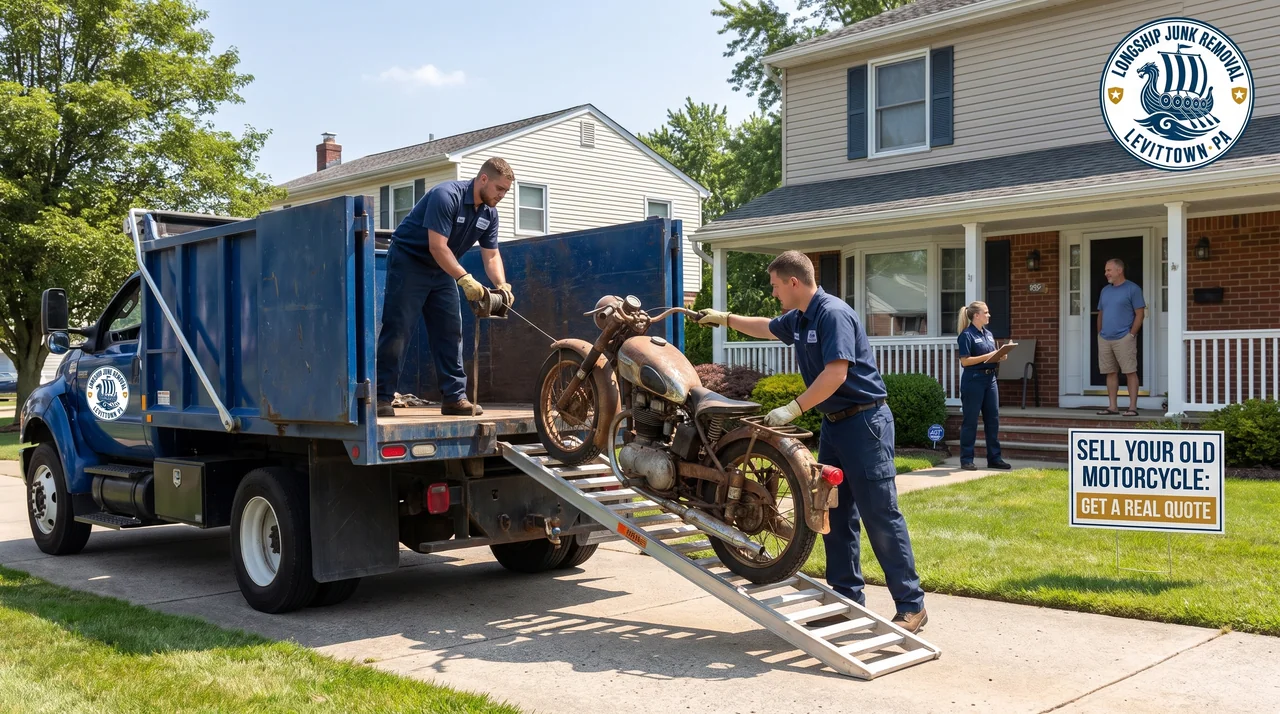
Longship Junk Removal of Levittown is a full-service junk removal and cleanout crew serving Levittown and Lower Bucks County. Our menu covers furniture, appliances, and garage, basement, and shed cleanouts. Complete motorcycles aren’t on that standard list, so tell us the year, make, and model and we’ll tell you straight whether we can haul yours.
A bike buried in a garage we’re already clearing is the most natural fit. Where the bike might be worth real money, call a specialist first.
Some things stay off the truck no matter what. We don’t take fuel, oil, other flammables, or household hazardous waste. If your bike still has gas in the tank or a battery in place, plan to deal with those separately. The price we quote before loading is the most you pay, and seniors and veterans get 10% off. For a free, no-obligation quote on a bike that’s part of a larger cleanout, call (267) 609-9327.
Frequently Asked Questions
Why can’t you give me a price on the first call?
A price depends on year, make, model, and condition, and none of that is settled in a one-minute call. The first call collects your name, number, and bike details. Someone at the office then reviews them and calls you back with a number you can rely on.
Is a 1979 Honda CBX worth more than scrap?
Quite possibly. It’s a six-cylinder model collectors recognize, even when it doesn’t run. Check recent sold listings for similar bikes and consider asking a classic-bike specialist before you let anyone scrap it. We can’t promise a figure, and condition changes everything.
Can I sell a motorcycle without a title in Pennsylvania?
It’s difficult. The title proves ownership, and many buyers won’t touch a bike without one. Bikes with no title tend to go to parts buyers or scrap. Contact PennDOT about replacement or other paperwork options for your situation before you list the bike.
Does a motorcycle have to run to be sold?
No. Parts buyers and some collectors take non-runners, usually at a lower price than a bike that starts. Clear photos and an honest description of what’s wrong help a buyer price it fairly, and they save you a round of back-and-forth.
What should I do with the gas, oil, and battery?
Don’t pour fuel or oil on the ground or down a drain, and don’t put a battery in the trash. All three count as hazardous. Bucks County holds household hazardous waste collection events, so check the county’s schedule for the next date.
Do you remove old motorcycles?
Complete motorcycles aren’t on our standard service list. Call with the year, make, and model, plus a note on whether it runs and where it sits. We’ll tell you plainly whether we can take it or whether a specialist buyer is the better route.
What to Do Today
Start with the identity of the bike. Write down the year, make, and model, take your photos, and find the title. Then decide whether you’re chasing a sale or just clearing space. If it’s the second, and the bike sits in a garage you’re cleaning out, we can talk it through.
Got an old motorcycle in a garage or shed cleanout? Give us the year, make, and model and we’ll tell you if we can haul it. Call (267) 609-9327 for a free, no-obligation quote.
Sal is the voice of the Longship crew — 15+ years clearing garages, basements, attics, and whole estates across Levittown and Lower Bucks County. His rule: you get one upfront price before anything moves, and that price is the most you pay. He writes here about what the crew actually meets inside Levittown homes, and what a job really costs. Sal is Longship's illustrated crew character — the brand's voice, not a staff member.