Selling a 1997 Ford E250 Van in Philadelphia: What They’ll Ask and Your Real Options
Written by: Sal, The Longship Crew · Levittown, PA
Last updated: 8 min read
Table of Contents
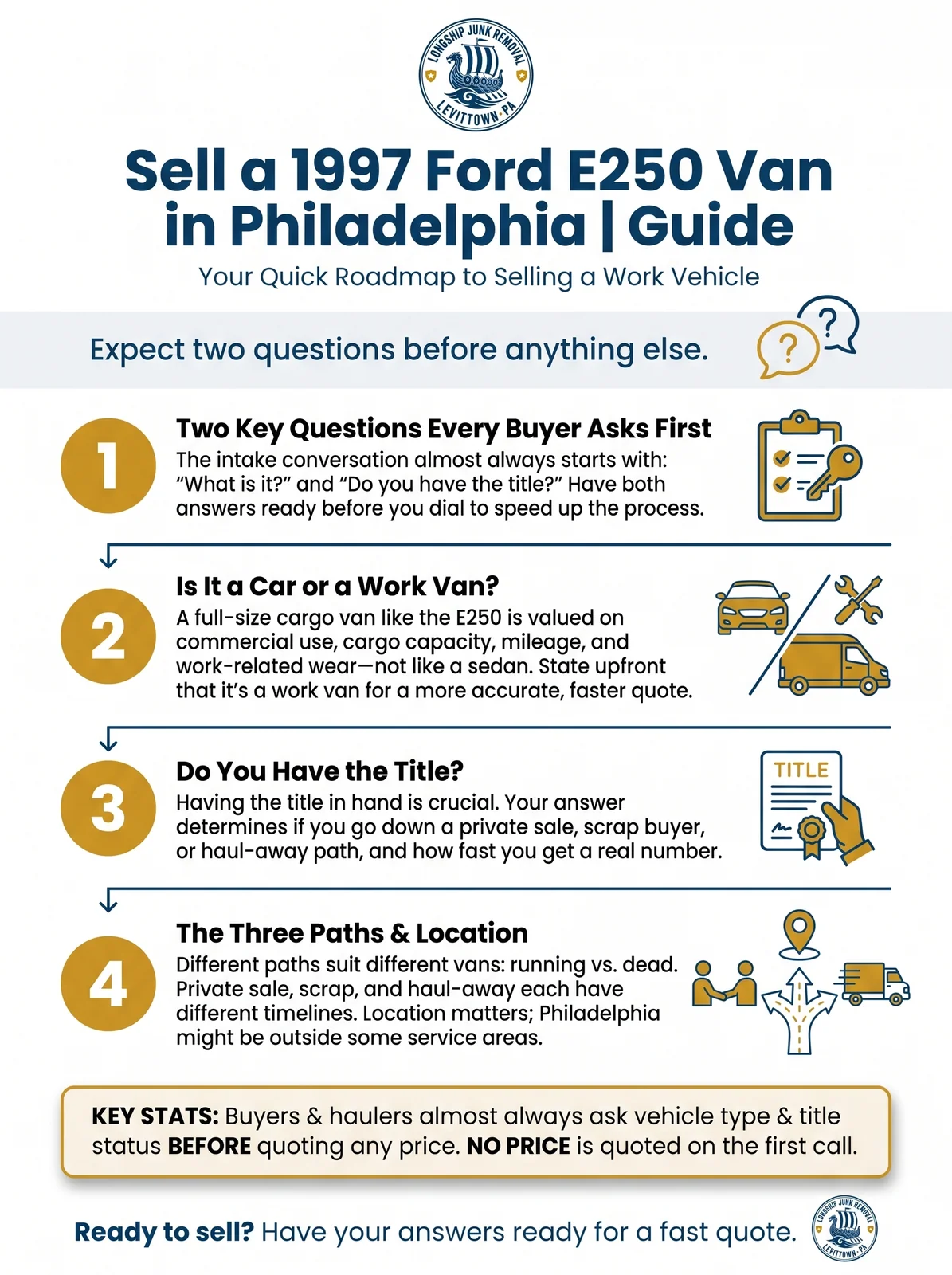
If you want to sell a 1997 Ford E250 work van in Philadelphia, expect two questions before anything else: is it a work van or a passenger car, and do you have the title in hand. Your answers decide which path fits — a private sale, a scrap buyer, or a haul-away service — and how fast you get a real number back.
Buyers and haulers almost always ask vehicle type and title status before anything else.
A running work van and a dead one lead down two very different paths.
Private sale, scrap buyer, and haul-away each suit a different situation and timeline.
No price gets quoted on the first call — that comes after details are confirmed.
Location matters: a van sitting in Philadelphia may fall outside a company’s usual service area.
The Two Questions Every Buyer Asks First
Whether you call a private buyer, a scrap yard, or a hauling company about your 1997 Ford E250, the intake conversation almost always starts the same way: what is it, and do you have paperwork to prove you own it. Have both answers ready before you dial, and the whole process moves faster.
“Is It a Car or a Work Van?”
A full-size cargo van like the E250 isn’t valued the same way as a sedan. It’s judged on commercial use, cargo capacity, mileage, and how much rust or wear the body has taken from years of work duty. Saying upfront that it’s a work van — not a passenger car — helps whoever picks up the phone route you to the right quote faster, instead of guessing from a vague description.
“Do You Have the Title?”
This is the gating question. A clear title in your name is what turns a casual conversation into an actual sale. With it, a private buyer or a legitimate scrap buyer can complete the transaction cleanly. Without one, your options shrink fast — some buyers won’t touch a vehicle at all, and others will only take it through a more limited process. If your title is lost or the van has a lien still attached, sort that out with PennDOT before you start shopping the van around; it will save you a dead-end conversation later.
What a 1997 Ford E250 Is Actually Worth
There’s no single number for a 25-plus-year-old work van. Value depends on whether it runs, how many miles are on it, how much rust has set in, and whether it ends up sold whole, sold for parts, or sold as scrap metal. On an initial call, don’t expect a dollar figure — that comes after someone has the full picture: condition, mileage, location, and title status.
Running and Usable vs. Dead and Scrap
A running E250 that still does its job has a real shot at a private sale, especially to a small business, contractor, or tradesperson who just needs a cheap, reliable cargo van. A van that no longer runs, or one with serious frame or engine problems, usually makes more sense as a scrap or parts sale. Metal weight and scrap pricing drive that number far more than the van’s original sticker price ever did.
Your Three Realistic Paths to Sell or Remove It
Once you know the van’s condition and have your title sorted, there are really only three routes worth considering.
Private Sale
This fits a running, usable work van. You list it, buyers ask about mileage and service history, and a clean title makes the handoff simple. It usually takes the longest of the three options, but it can also put the most money in your pocket if the van still has life left in it.
Scrap or Junk-Vehicle Buyer
This is the fallback for older or non-running vans. Scrap buyers price mainly off weight and current metal values, not the van’s age or original features. Most want a title in hand to complete the paperwork; if you don’t have one, ask directly what their process allows before you tow it anywhere.
Haul-Away or Removal Service
This is the path a lot of owners actually take without realizing it — calling a hauling-type company instead of a dealer or scrap yard. In practice, this usually works as a lead-and-callback process: you give your vehicle type, location, and title status, and someone follows up with next steps rather than a number on the spot. Whether a specific hauling company buys or removes vehicles at all is worth confirming directly with them — it’s not something every junk-removal or hauling business handles.
Path
Best For
Title Needed?
Typical Timeline
Private sale
Running, usable work van
Yes, clean title
Longest — days to weeks
Scrap or junk-vehicle buyer
Non-running or heavily worn van
Usually yes
Fast — often same week
Haul-away / removal service
Owners who want it gone with minimal effort
Usually required
Callback first, then scheduled pickup
What Information to Have Ready Before You Call
Whoever answers the phone will walk you through a short set of questions before anything else happens. Have these ready and the call moves quickly:
Vehicle type — a work or cargo van, not a passenger car.
Make, model, and year — for example, a 1997 Ford E250.
Your city or ZIP code — location affects who can realistically come get it.
Whether you have the title in hand, and whose name it’s under.
Whether the van currently runs or is sitting dead.
Walking in with those five answers is exactly what separates a five-minute call from a back-and-forth that goes nowhere.
Does Being in Philadelphia Change Anything?
Yes — where the van sits affects who’s willing and able to come get it. Some hauling and removal companies work a tight local radius and won’t travel outside it; others cover a wider region. If you’re calling a company based in Bucks County, for instance, a Philadelphia address is outside their core footprint, and it’s worth asking about service area before you get too far into the conversation. Confirming coverage upfront saves both sides a wasted trip.
Got Junk Piling Up Along With the Van?
If the van isn’t the only thing cluttering up your garage, driveway, or work site, that’s a separate but related problem worth solving at the same time. Longship Junk Removal of Levittown handles full-service junk removal and whole-property cleanouts across Levittown and Lower Bucks County — furniture, appliances, construction debris, and garage or basement clear-outs — with one upfront price locked in before anything gets loaded.
Clearing out more than just a vehicle? Call (267) 609-9327 for a free, no-obligation quote on your junk removal or cleanout job across Levittown and Lower Bucks County.
Frequently Asked Questions
Do I need the title to sell my old Ford E250?
In most cases, yes. A clear title in your name is what makes a private sale or a legitimate buyer pickup possible. Without one, your options narrow considerably, often down to certain scrap-buyer processes. If your title is missing, check current requirements with PennDOT before trying to sell.
Is a 1997 work van worth anything if it doesn’t run?
Often, yes — even a non-running E250 can carry scrap or parts value tied to its weight and current metal pricing. That figure only gets confirmed after someone reviews the van’s details, not on a first phone call, so don’t expect a number right away.
What’s the difference between selling a van and having it hauled away?
Selling means finding a buyer who pays you for the van, whether it’s a private buyer or a scrap yard. A haul-away or removal service is more about getting an unwanted vehicle gone, sometimes for a small payout, sometimes for a fee — it’s a different goal even though both start with a phone call.
Will a junk removal company take my van in Philadelphia?
It depends on the company. Some hauling and removal businesses handle vehicles, others focus strictly on household and property junk, and service area plays a big role too. Always confirm directly whether a company removes vehicles and whether they cover your city before assuming they will.
What will they ask me when I call?
Expect four questions right away: what kind of vehicle it is (car versus work van), the make, model, and year, your city or ZIP code, and whether you have the title in hand. Those answers determine which of your options are actually available.
Selling or removing an old work van doesn’t have to be complicated once you know the questions coming your way. Confirm your title status, be honest about the van’s condition, and pick the path — private sale, scrap buyer, or haul-away — that actually fits your situation. If you’re also staring down a garage or property full of clutter, call (267) 609-9327 and get a straight, upfront quote on the rest.
Sal is the voice of the Longship crew — 15+ years clearing garages, basements, attics, and whole estates across Levittown and Lower Bucks County. His rule: you get one upfront price before anything moves, and that price is the most you pay. He writes here about what the crew actually meets inside Levittown homes, and what a job really costs. Sal is Longship's illustrated crew character — the brand's voice, not a staff member.