How to Clean Out a Basement in Levittown, PA: Step by Step
Written by: Sal, The Longship Crew · Levittown, PA
Last updated: 10 min read
Table of Contents
Cleaning out a basement in Levittown means sorting everything into keep, donate, recycle, and haul piles, working section by section, and figuring out how the heavy stuff gets up the stairs. Many Levittown homes are one of six original Levitt house models, so basement layouts tend to be predictable — which makes planning the job a lot easier.
What to know before you start:
Sort into four categories from the start — re-sorting the same box twice wastes hours.
Two-story Colonial and Country Clubber models have basement staircases that are the real bottleneck, not the sorting.
PA bans e-waste like TVs and computers from curbside trash, and old Freon appliances need proper handling.
Paint, chemicals, and propane tanks can’t go in a regular junk load — they go to a Bucks County household hazardous waste event.
You have three real disposal paths: DIY trips, a rented dumpster, or a full-service crew that does the lifting for you.
Quick Overview: The Basement Cleanout Process
Before getting into the details, here’s the full arc of a basement cleanout from start to finish:
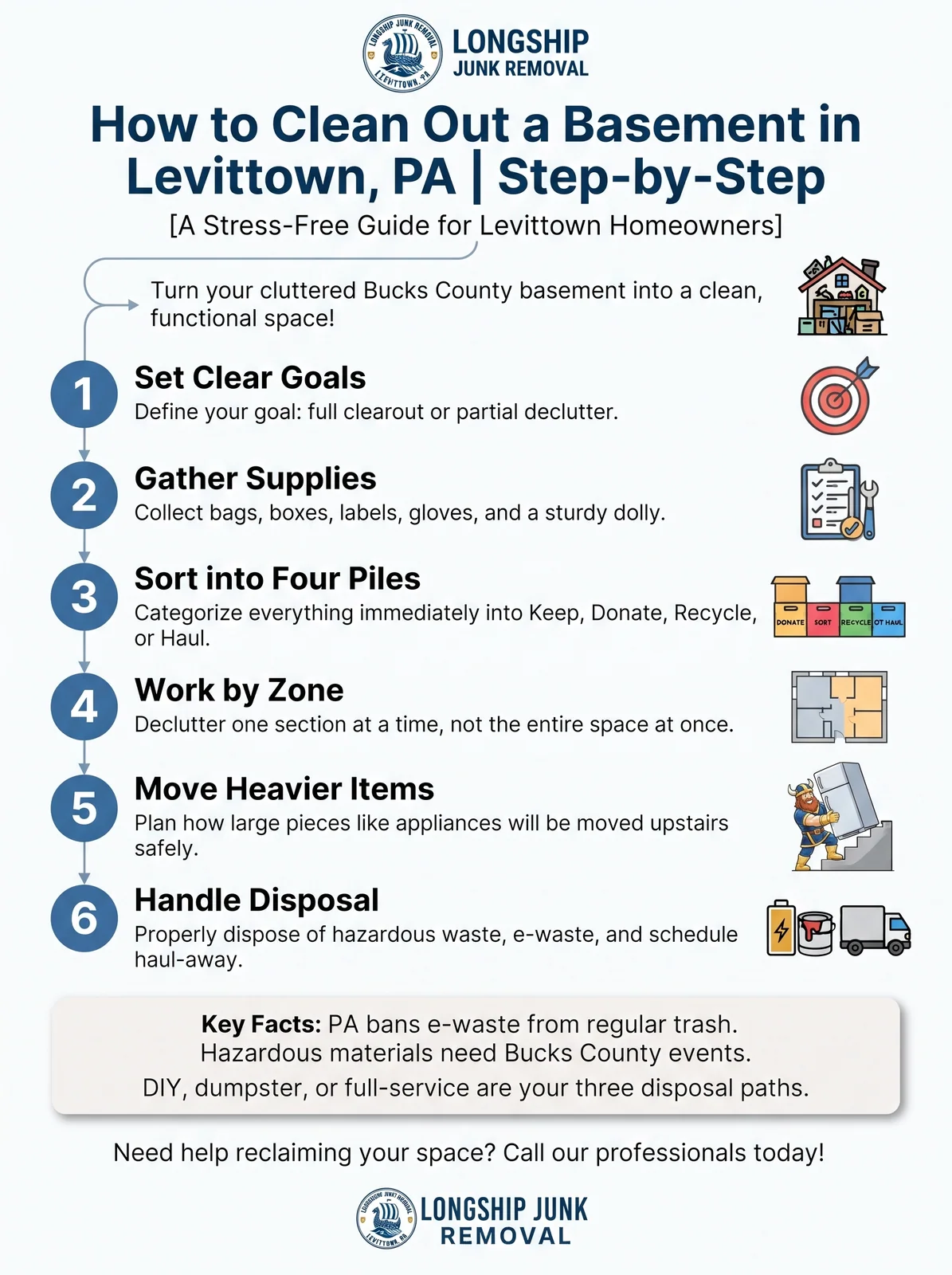
Set a clear goal — full clearout or partial declutter.
Gather supplies: bags, boxes, labels, gloves, and a dolly.
Sort every item into keep, donate, recycle, or haul.
Work one zone at a time instead of the whole space at once.
Move items out, starting with the heaviest and most awkward pieces.
Handle disposal and recycling, including hazardous materials and e-waste.
Sweep, check for moisture, and reset the empty space.
Each of these steps is worth slowing down on, especially in an older Levittown basement that’s been collecting boxes since the house was built.
Before You Start: Plan and Gather Supplies
A basement cleanout goes faster when you decide the goal before you touch a single box. Are you clearing the whole space, or just reclaiming half of it for storage? Block out a realistic window of time, and plan around the stairs early — that’s the detail people forget until a couch is halfway up a narrow Colonial or Pennsylvania Colonial staircase.
Supplies Checklist
Heavy-duty contractor bags for loose debris and soft items
Sturdy boxes for anything with weight or sharp edges
Markers and labels for keep/donate/recycle/haul piles
Work gloves and dust masks — basements collect dust, dander, and mildew
A box cutter for breaking down cardboard as you go
A hand truck or dolly for appliances and heavy furniture
Basic cleaning supplies for the finish once the space is empty
Set a Realistic Timeline
A light declutter of a mostly organized basement can be done in a weekend. A basement that’s held decades of accumulated belongings — common in homes built during Levittown’s original 1950s development — often takes several days, especially if furniture needs to be broken down or hauled out in pieces. Give yourself more time than feels necessary; basements always hide one more corner.
Step 1: Sort Everything Into Four Categories
The fastest method is a simple four-pile system: keep, donate, recycle, and haul away. Touch each item once and make a decision immediately — resorting the same pile twice is where most weekends get lost. Label each zone clearly with tape or a sign so anyone helping knows exactly where things go.
Deciding What to Keep
Keep what you’ve actually used in the last year, what has genuine sentimental value, or seasonal items that have a real home upstairs — not just a corner of the basement. Be honest about “might need it someday” boxes. That mindset is exactly what refills a basement a year after it’s cleared.
What to Donate vs. Recycle
Usable furniture, working small appliances, and household goods in decent shape can go to local donation. Broken electronics, scrap metal, and flattened cardboard belong in recycling instead. One local detail worth knowing: Pennsylvania bans e-waste — TVs, monitors, computers, printers — from curbside trash, so those items need to go to a proper recycler rather than the regular garbage.
Step 2: Work in Zones, Not All at Once
Instead of attacking the entire basement in one pass, divide it into sections — the storage wall, the laundry area, the workshop corner — and finish each one completely before starting the next. This keeps the job from feeling endless and gives you visible progress to point to. Levittown basements tend to be compact and already naturally divided by function, which makes zoning an easy method to apply.
Step 3: Handle the Heavy and Awkward Items
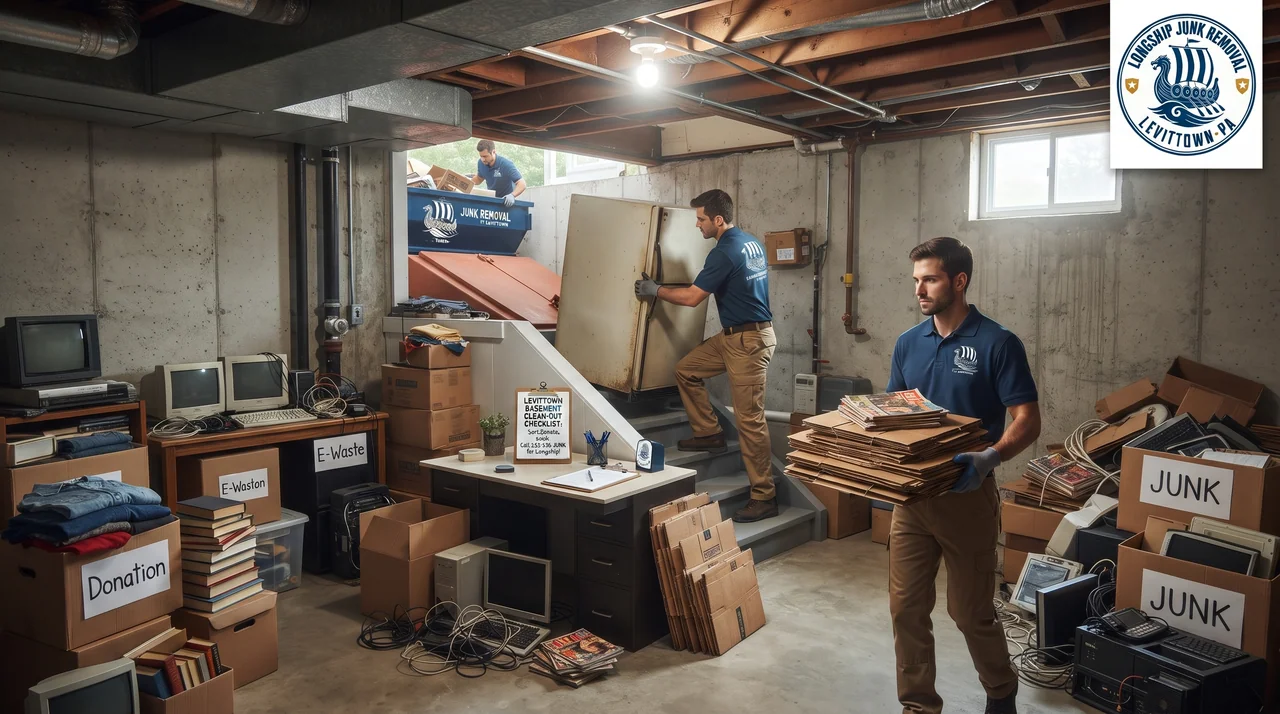
Furniture, old appliances, and bulky items are where a basement cleanout gets physical. Protect walls and stair edges before moving anything large, use proper lifting technique, and don’t try to solo a heavy piece down a narrow staircase. In two-story Levitt models like the Colonial and Country Clubber, the basement stairs are the real obstacle — single-floor Ranchers and Levittowners are a more straightforward haul-out by comparison. A second set of hands or a dolly makes a real difference here.
Old Appliances and Freon Units
Refrigerators, freezers, and window air conditioners contain refrigerant that requires proper handling under state regulations — you can’t just set one at the curb and walk away. This is one area where a professional crew’s experience actually matters, since improper handling of Freon units is both against the rules and bad for the environment.
Mattresses and Box Springs
Mattresses and box springs are bulky, awkward to bag, and often not accepted in regular municipal trash pickup at all. They usually need a dedicated bulk pickup, a transfer station drop-off, or a hauling service that takes them directly.
Step 4: Deal With Hazardous Materials Safely
Some items should never go in a regular trash pile or a junk load, including:
Paint, solvents, and oils
Pesticides and other lawn or garden chemicals
Propane tanks and other flammables
Household chemicals in general
These materials need to go to a Bucks County household hazardous waste collection event rather than the curb or a standard haul. It’s an extra step, but it’s the correct — and legal — way to get rid of them.
Comparing Your Disposal Options
Once everything is sorted, you still need to get it out of the house. Here’s how the three common routes stack up:
Method
Effort Required
Best For
Watch Out For
DIY trips (truck rental or car loads)
High — you load, drive, and unload every trip
Small basements, light clutter
Municipal bulk-pickup rules and limits vary by township
Dumpster rental
Medium — you load it yourself over several days
Larger, ongoing projects with time to spare
Needs driveway space and sometimes a permit
Full-service junk removal crew
Low — the crew does the lifting and hauling
Heavy items, tight stairs, full or hoarding-level cleanouts
Choose a crew that sorts for donation and recycling, not just landfill
DIY Trips to the Transfer Station or Curbside Pickup
This route means renting a truck or making several car trips, and checking your township’s bulk-item pickup rules and volume limits before you start. It’s the least expensive option in materials, but it costs the most in time and physical effort — especially for anything heavier than a few boxes.
Renting a Dumpster
A roll-off dumpster gives you days to fill it at your own pace, which works well for a large, ongoing project. The tradeoff is that you’re still doing all the loading yourself, and you’ll need enough driveway space (and sometimes a township permit) to have one sitting on the property.
Hiring a Full-Service Junk Removal Crew
A full-service crew handles the entire haul in one visit — they carry everything out, load the truck, and sort usable items for donation while recycling what they can. This is also the option that takes the Freon and e-waste compliance questions off your plate, since a crew already knows how those items need to be handled.
Step 5: Clean the Empty Basement
Once the space is cleared, sweep thoroughly and check for signs of moisture, mildew, or pests — common in older basements that have sat packed and undisturbed for years. Wipe down surfaces, and consider adding shelving or labeled bins before you start putting anything back. A broom-clean finish is what actually keeps a basement from filling back up.
Tips to Keep Your Basement Clutter-Free
Follow a one-in-one-out rule for anything new that goes into storage
Use labeled bins instead of loose boxes so contents stay visible
Do a short annual mini-declutter instead of waiting for another full cleanout
Keep walkways and the stair landing clear at all times
Store seasonal items in one dedicated section, not scattered across the room
Considering Professional Help in Levittown
A DIY cleanout works fine for a light basement. But if you’re dealing with heavy furniture, a tight stairwell, a full estate cleanout, or simply no time to spare, bringing in a local crew is often the more practical route.
Longship Junk Removal of Levittown handles full-service basement cleanouts across Lower Bucks County, with one upfront price locked in before anything gets loaded and same-day availability when you need it gone fast. The crew works from any floor of the home — including the classic Levitt basement walk-down — and knows all six house models and the 41 named sections of Levittown, so quoting the job is quick. Seniors and veterans get a 10% discount on the total price.
Ready to get the basement cleared without lifting a thing? Call (267) 609-9327 for a free, no-obligation quote — the price we give you is the most you’ll pay.
Frequently Asked Questions
How long does it take to clean out a basement?
It depends on size and clutter level. A light declutter can take a single weekend, while a fully packed basement may take several days. Working in zones and having a clear disposal plan for each category speeds up the whole process.
What should you not put in a junk pile or regular trash?
Hazardous materials — paint, solvents, oils, pesticides, and propane tanks — should never go in regular trash or a junk pile. E-waste and Freon appliances are also regulated in Pennsylvania and need to go to a proper recycler or a household hazardous waste event instead.
What’s the best way to get rid of heavy furniture from a basement?
Use a dolly, protect the walls and stair edges, and work with a second person for any real lifting. In two-story Levitt models like the Colonial, the basement stairs are the main challenge — a full-service crew is built to handle exactly that kind of walk-down.
Can I donate items from my basement cleanout?
Yes. Usable furniture, working appliances, and household goods in decent condition can go to local donation. Broken items and non-working electronics should be recycled rather than donated, since most donation centers won’t accept them anyway.
How much does it cost to clean out a basement in Levittown?
Cost depends on volume and the method you choose — DIY trips, a dumpster rental, and full-service removal each price out differently. A full-service crew typically gives one upfront price based on the truck space your items fill. Getting a free quote is the fastest way to a real number.
Do junk removal companies clear out hoarder basements?
Yes, many full-service crews handle hoarding and estate-level cleanouts, working room by room and taking extra care with items that carry sentimental weight. This comes up often in Levittown, especially with older or inherited homes that have decades of accumulated belongings.
What to Do Next
Start with the four-pile sort, work one zone at a time, and plan for the stairs before you plan for anything else. If the job turns out bigger than a weekend can handle, a full-service crew can finish it in a single visit — call (267) 609-9327 for a free quote and get the basement back to usable space.
Sal is the voice of the Longship crew — 15+ years clearing garages, basements, attics, and whole estates across Levittown and Lower Bucks County. His rule: you get one upfront price before anything moves, and that price is the most you pay. He writes here about what the crew actually meets inside Levittown homes, and what a job really costs. Sal is Longship's illustrated crew character — the brand's voice, not a staff member.