How to Junk or Sell Your Ford F-150 Pickup Truck: Start With the Year, Title, and Condition
Written by: Sal, The Longship Crew · Levittown, PA
Last updated: 11 min read
Table of Contents
If your Ford F-150 pickup truck runs and has a clear title, selling it usually returns the most money. If it’s dead, wrecked, or not worth repairing, a scrap or junk-car buyer is the fast route. Three facts decide which path fits: model year, condition, and title. Sort those out first.
What to know before you call anyone
“Get rid of my truck” is a decision, not a job order. Choose sell, scrap, or donate before you dial.
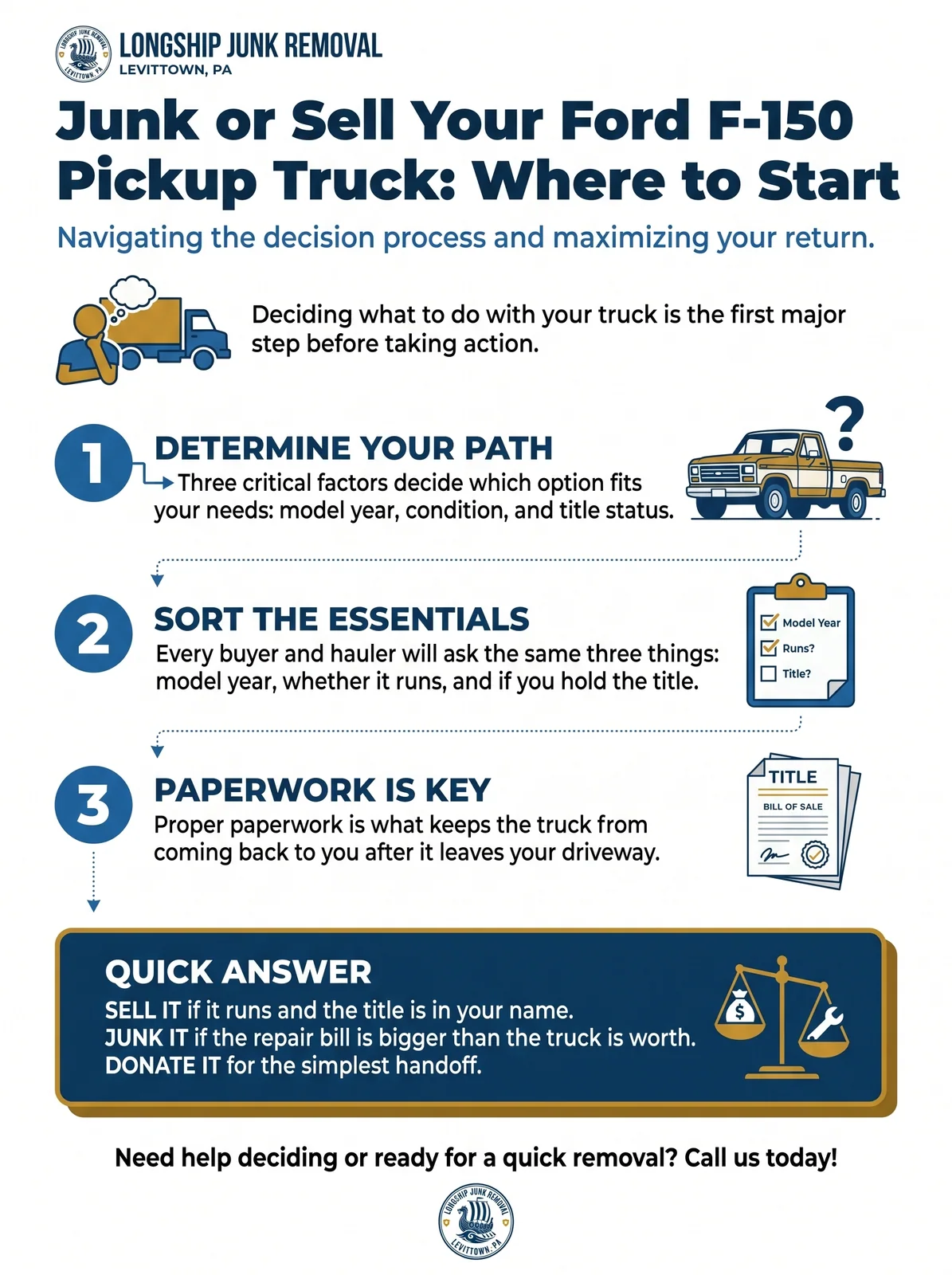
Every buyer and hauler will ask the same three things: the model year, whether it runs, and whether you hold the title.
A whole vehicle usually needs a tow truck or a vehicle buyer, not a junk-removal crew.
Paperwork is what keeps the truck from coming back to you after it leaves your driveway.
Quick answer: junk or sell your F-150 pickup truck?
Sell it if it runs and the title is in your name. Junk it if the repair bill would be bigger than the truck is worth. Donate it if you want the simplest handoff and don’t need the cash. The table below puts the five realistic options side by side.
Path
Best when
Speed
Effort
What you need
Sell privately
Runs and drives, clean title
Slowest
High: listings, calls, meetups
Title, bill of sale, ID
Trade-in or instant offer
You want it done in a day or two
Fast
Low
Title or payoff info, VIN, keys
Sell for parts
Engine, body panels, or interior are in good shape but the truck won’t run
Slow
High: several buyers, possible dismantling
Title, VIN, photos of the parts
Junk or scrap
Wrecked, dead, or not worth repairing
Fast, often within days
Low
Title and ID, usually
Donate
Running or repairable, and you value convenience over cash
Moderate
Low
Title, a pickup window
Speed and money pull in opposite directions here. A private sale pays best and takes the most of your evenings. A scrap pickup pays less and can be over by Thursday. Pick the one you can live with.
The three questions every buyer or hauler asks first
A caller recently told our intake line, twice, that he wanted to get rid of his pickup truck. When the agent asked for the year, make, and model, all she got was “F-150 Ford.” Nobody did anything wrong. But a buyer can’t price that, and a tow company can’t dispatch on it.
Have these three answers ready and any quote gets faster and more honest.
What model year is your F-150?
The year sets the baseline for value, whether you sell or scrap. The F-150 has been redesigned several times, and two breaks matter most. Ford moved to an aluminum body around the 2015 model year, and a new generation arrived with the 2021 trucks. Parts buyers care about those lines because panels and components don’t always swap across them.
One more version to flag: the F-150 Lightning is electric. Its high-voltage battery changes how it’s valued and how it gets disposed of, so tell any buyer up front if that’s what you own.
Can’t remember the year? Check the sticker inside the driver’s door jamb, the title, or the registration card. The VIN also encodes it.
Does it run, drive, or neither?
Buyers sort trucks into three bins. Runs and drives means it starts and moves under its own power. Runs but needs work means the engine turns over, but something stops it from being road-safe, such as brakes, steering, or a failed inspection. Doesn’t run means it won’t start or won’t move.
The bin decides who wants it. A running truck appeals to private buyers and dealers. A non-runner needs a tow, and it usually goes to a parts seller or scrap yard. Big problems like a failed transmission, a blown engine, or heavy body damage pull the price down fast, and sometimes the truck is worth more in pieces than whole.
Do you have a clear title?
A clear title is in your name, with no lender listed. Anything else changes your options. If you still owe money, the lender holds a claim on the truck, and you’ll need a payoff figure and a lien release before it can legally change hands. If the title is lost, you’ll generally need a duplicate first. A salvage or rebuilt brand on the title is disclosed to every buyer and lowers what they’ll pay.
Most legitimate buyers and scrap yards want proof of ownership. For the exact Pennsylvania steps, such as PennDOT title transfers, duplicates, and lien releases, check PennDOT’s current instructions before you set a price.
How to sell an F-150
Selling makes sense when the truck has real life left in it. Full-size pickups tend to hold steady demand, which helps. Here’s how the three selling routes differ.
Sell it privately
Start with price research. Look at comparable F-150 listings near you with the same year, trim, and mileage, and cross-check against a pricing guide you trust. Then photograph the truck in daylight, interior and bed included, and show the dents. A buyer who finds a flaw in person starts haggling; one who saw it in the photos doesn’t.
Write a plain description: year, trim, engine, mileage, known problems, and why you’re selling. Meet in a public place, ride along on the test drive only after you’ve checked the driver’s license, and take payment in a way that clears before the keys change hands. Sign a bill of sale with both names and the date.
Trade it in or take an instant offer
A dealer trade-in or an online instant offer is the low-effort route. They’ll verify the VIN, inspect the condition, and check the title. You usually leave money on the table compared with a private sale. It’s worth it when your time matters more than the gap, or when you’re buying another vehicle anyway.
Sell it for parts or as-is
For a truck that won’t run or has damage, parts sellers, salvage auctions, and independent mechanics are the audience. Strong demand for F-150 components can put the total above scrap weight, especially if the drivetrain or body is intact. The trade-off is a longer process: several buyers, maybe dismantling, and a lot of back-and-forth. Do it only if you have the patience.
How to junk an F-150
Junking is the right call when the truck is past saving. The real question is who actually takes a whole vehicle.
Scrap yards and junk-car buyers
Scrap pricing generally follows weight and current metal prices, with adjustments for what’s still on the truck. Ask whether the quote assumes the battery and catalytic converter are included, because those can change the number. Many buyers include a free tow and can pick up within a day or two.
Get two or three quotes. One call isn’t a price, it’s an opening bid.
What a junk-car buyer will usually ask you
Expect questions about the year and model, whether it starts, whether the wheels and engine are still attached, where the truck is parked and whether a tow can reach it, and whether you hold the title. Have those answers ready and the call takes a couple of minutes.
Why a junk-removal crew isn’t the usual answer for a whole truck
This is where the caller above got stuck, and he’s not alone. Junk-removal crews load furniture, appliances, mattresses, and general debris onto a box truck. A whole vehicle needs a tow truck or a licensed vehicle buyer, and most junk-removal companies don’t take them.
Whole vehicles aren’t part of our standard service menu at Longship. Whoever you call, ask before you assume.
Donating an F-150
Many charities accept running or repairable vehicles and arrange the pickup themselves. Tax-deduction rules on vehicle donations are specific, so ask the charity and your tax preparer what applies to you. A truck that won’t run or is badly damaged may be turned down, so confirm before you schedule anything.
Paperwork to finish in Pennsylvania
Handing over a truck without paperwork can leave your name tied to it. Parking tickets, tolls, or an accident after the handoff can land on you. Pennsylvania’s steps and forms change, so confirm the current ones with PennDOT. This checklist covers the usual ground.
Before the F-150 leaves your driveway
Clean out the truck before it leaves
You’d be surprised what hides in an old pickup. Go through it slowly, section by section.
Seat backs and door pockets: receipts, tire gauges, sunglasses
Toolbox and bed: straps, chains, tools, tie-downs
Under the seats and in the cab corners: loose change, phone chargers, anything with your address on it
Plates and any toll transponder stuck to the windshield
If the truck has been sitting a while, check the driveway or garage around it too. In Levittown’s older sections, an old pickup often parks next to a garage that’s full of everything else.
If the truck is part of a bigger cleanout
Sometimes the truck is only one piece of the project. The garage behind it is stacked with furniture, the basement has a dead washer, and the whole property needs to be cleared before a sale or a move.
That part we do. Longship Junk Removal of Levittown hauls furniture, appliances, and general clutter across Levittown and Lower Bucks County. You point at it, our crew carries it out, and you get one upfront price before anything is loaded.
Clearing a garage or driveway around an old truck? Call (267) 609-9327 for a free quote on the rest of the cleanout, and ask us about the vehicle too. We’ll tell you plainly what we can and can’t take.
Mistakes to avoid when letting go of a truck
Accepting the first scrap quote. Two or three calls take ten minutes and can move the number.
Skipping the bill of sale because the buyer seems friendly.
Leaving the plates on the truck.
Cancelling insurance before the transfer is done, which leaves you uncovered while the truck is still yours.
Paying an upfront “tow fee” or deposit to a buyer you can’t verify. A legitimate buyer pays you; you don’t pay them to take your truck.
Letting the truck sit unlisted for months while the value drops.
What to do next
Write down the model year, trim, mileage, and whether it runs.
Find the title, or start a duplicate if it’s lost.
Call two or three buyers and compare the quotes.
Confirm the pickup time and complete the paperwork on the spot.
Cancel the registration and insurance after the transfer.
Once the truck is gone, we can help clear what’s left. Call (267) 609-9327 and we’ll quote your garage, basement, or yard cleanout before a single thing gets loaded.
Frequently asked questions
Is it better to sell or junk a Ford F-150?
Sell it if it runs and the title is in your name, because that usually returns more. Junk or scrap it if repairs would cost more than the truck is worth, or if it won’t run at all. Year, condition, and title decide.
What do I need to junk my truck in Pennsylvania?
Generally proof of ownership, meaning the title, plus a photo ID. Requirements vary by buyer, so ask each one what they’ll want, and check PennDOT’s current rules.
Can I junk an F-150 without a title?
Sometimes. A few buyers accept alternative proof of ownership, but many won’t. Getting a duplicate title is the cleaner route and tends to get you a better offer. Confirm Pennsylvania’s current process with PennDOT.
Will a junk-removal company haul away a whole truck?
Most junk-removal crews take household items and debris, not whole vehicles, which need a tow or a vehicle buyer. Ask any company before booking. Whole vehicles aren’t on our standard list at Longship, so call us if you’re not sure.
How much is an F-150 worth for scrap?
It depends on the truck’s weight, current scrap metal prices, and what’s still on it. There’s no fixed number. Get two or three quotes, and ask what each one includes.
Should I sell an F-150 for parts?
It can pay more than scrap if the engine, body panels, or interior are in good shape. It also takes more time, more phone calls, and sometimes the work of pulling parts yourself.
Do I need to cancel my insurance after selling the truck?
Yes, once the title transfer is complete. Keep a copy of the bill of sale and the signed paperwork as proof. Check Pennsylvania’s current requirements for registration and insurance notices.
Sal is the voice of the Longship crew — 15+ years clearing garages, basements, attics, and whole estates across Levittown and Lower Bucks County. His rule: you get one upfront price before anything moves, and that price is the most you pay. He writes here about what the crew actually meets inside Levittown homes, and what a job really costs. Sal is Longship's illustrated crew character — the brand's voice, not a staff member.