Junk Car Removal Estimate in Philadelphia: What to Have Ready and What Happens After You Ask
Written by: Sal, The Longship Crew · Levittown, PA
Last updated: 11 min read
Table of Contents
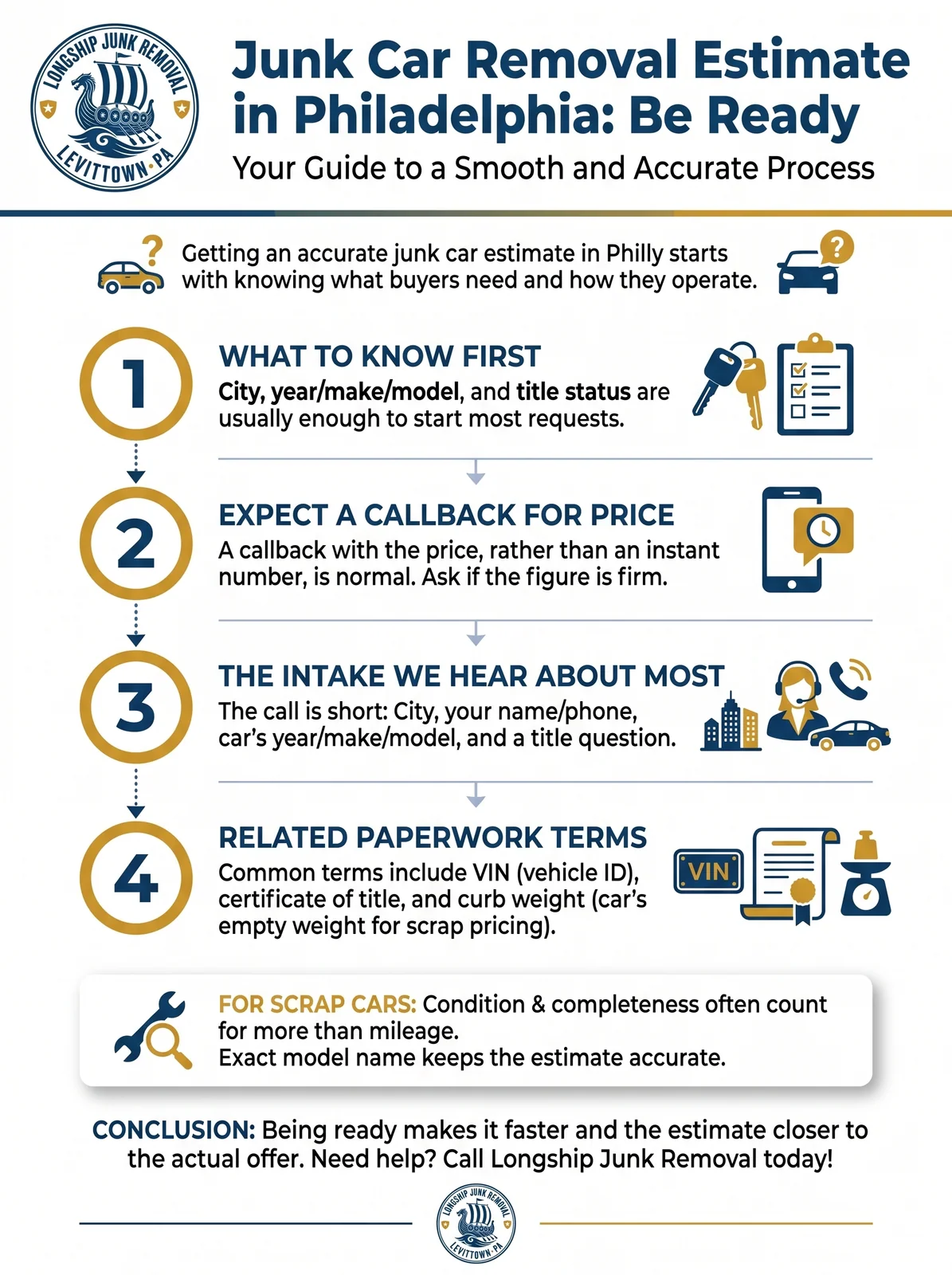
A junk car removal estimate in Philadelphia usually starts with four facts: the car’s year, make and model, the city it sits in, and whether you hold the title. Many buyers collect those details first and call back with a number later. Expect a callback, not an instant price.
What to know first
City, year/make/model and title status are enough to start most requests.
For a car headed to scrap, condition and completeness often count for more than mileage.
Getting the exact model name right keeps the estimate from drifting.
A callback with the price, rather than a number on the first call, is a normal sequence.
Ask whether the figure is firm before you agree to anything.
What a junk car estimate actually needs from you
Very little, at first. The intake we hear about most goes in this order: your city, your name and phone number, the car’s year, make and model, and one question about the title. That’s it. The call is short.
Being ready makes it faster, and it makes the estimate closer to what you’ll actually be offered. If you’ve priced cleanouts for a living, you know a number is only as good as the details behind it. The same goes for a car. Related paperwork terms you may hear are VIN (the 17-character vehicle ID), certificate of title, and curb weight, which is what the car weighs empty and what scrap pricing often leans on.
Year, make, model, and your city
These three details come first because they identify the car. A 2006 sedan and a 2016 sedan can sit in very different places on a buyer’s list, even when they share a badge.
Your city or ZIP is usually enough to start. Nobody needs your street address up front. Location still matters later, since it affects how far a tow has to travel and which providers will come to you at all. Ask about towing charges when the number arrives rather than guessing at one now.
Get the model name exactly right
Here’s a mix-up we’ve seen play out on a call. A caller described a 2006 Buick as a “Luzerne,” then spelled out “LaCrosse.” Those are two different Buick models (Lucerne and LaCrosse are the real names), and the agent had to stop and untangle it.
It matters. Similar-sounding models can be valued differently, and demand for their parts can differ too. Don’t rely on memory.
Read it off the title or registration.
Check your insurance card.
Look at the VIN plate on the driver’s side of the dashboard or on the door jamb.
Spell the model out loud when you give it. It takes five seconds.
Your title: the one document that changes the conversation
“Do you have the title?” is one of the first questions for a reason. The title shows who owns the car, and a buyer generally needs that proof before taking it. A plain “yes” keeps the conversation simple. The full paperwork picture is in the Pennsylvania section below.
Does mileage matter for a junk car estimate?
Sometimes, but less than most people assume. One caller asked this directly (“it doesn’t matter, like mileage or anything, right?”) and got no real answer. Here’s the real one.
When a car will be resold as a running vehicle, mileage is a major factor. When it’s headed for scrap or parts, buyers more often look at condition, whether the car is whole, and what it weighs. Still, the person on the callback may ask for your mileage, so have a rough figure ready. Different buyers weigh these factors differently, and none of them can tell you the number until they see your details.
What usually matters more than mileage
Think of it as what a buyer pictures when you describe the car.
Running or not. Non-running cars are common, but say so up front.
Whole or stripped. A missing catalytic converter, engine or doors changes the math, since scrap metal prices and parts demand both depend on what’s still there.
Damage. Collision damage, flood history, fire.
Tires and wheels. Flat tires make loading harder.
Keys. No keys can mean a different towing method.
Access. A car on a narrow rowhouse block is harder to reach than one in an open driveway.
Details to have in your head before the callback
On that call, the question about condition never came up, and neither did where the car was parked. The agent’s only answer was that someone would ask later if needed. Don’t wait to be asked. You can answer all of these in half a minute.
Before they call you back
What happens after you submit your car’s details
The common pattern has two steps. First the intake: someone collects your details and sends them along. Then a callback, where a person reviews the car and gives you a number. As the agent put it, “I just send the information over and then they reach out.”
It’s normal. It doesn’t mean your request was ignored.
Why you may not get a price on the first call
An estimate needs a human to look at the details, compare them against current scrap and vehicle values, and often ask a follow-up question or two. That’s why the first person you talk to may not quote anything. A legitimate callback sounds like this: they confirm the car, ask about condition and location, then give you a figure and explain what it covers.
How long until someone contacts you
Nobody can promise you a window unless they’ve told you one. The caller asked, “Like today or tomorrow?” and heard, “I’m not so sure when.” Don’t hang up in that state.
Ask for a callback window while you’re still on the line.
Ask who will call and from what number, so you don’t ignore it.
Write down the date and time of your request.
If a day or two goes by with nothing, call back and ask for a status.
Questions to ask when the estimate comes in
Our rule on every job is that the price we quote is the most you pay. Hold any junk car buyer to something close to it. Ask these when the number arrives:
Is this number firm, or a starting point?
What could change it on pickup day?
Is towing included, and are there any fees?
How and when will I be paid?
What paperwork do you need, and what will I sign?
When can you actually pick it up?
Pennsylvania paperwork for a junk car in Philadelphia
Paperwork rules change, so treat this as the general picture and confirm details with PennDOT before you hand anything over. Broadly, you’ll want a signed-over title, a bill of sale for your own records, a plan for the license plate, and a call to your insurer so you stop paying for a car that’s gone.
If you have the title
This is the straightforward path, and it’s where the caller stood. You sign the title over to the buyer, keep a copy or photo of the signed document, and ask for a receipt or bill of sale. Before pickup, clear out personal items, registration and insurance papers, and any toll tag. Plate handling in Pennsylvania has its own rules, so ask PennDOT what to do with yours rather than leaving it on the car by default.
If the title is lost or not in your name
Options exist, such as applying for a duplicate title if the car is yours, but the requirements vary with your situation. A car inherited from a relative or bought without a title transfer is a different case from a misplaced paper. PennDOT is the source for current requirements. Don’t assume a buyer will take a car with no title, and be wary of anyone who promises it before asking a single question.
How to compare junk car offers in Philadelphia
Give every provider the same car details, the same condition notes and the same pickup location. Otherwise you’re comparing guesses. Then check what each number actually is.
Type of number
What it is
What to ask
Estimate
A rough figure based on the details you gave
What could move it?
Firm quote
A specific price confirmed after reviewing your car
Is it in writing, and does it include towing?
Price at the curb
What you’re actually paid when the car is picked up
Does it match the quote, and why not if it doesn’t?
Watch for a quote that changes once the driver arrives, or fees that appear only at the curb. A price that drops at pickup without a reason tied to the car’s real condition is a flag. In our line of work we’d call that the end-of-job surprise, and it’s the thing people dislike most.
Other options for an old car besides a junk car buyer
A junk car buyer isn’t your only route. It’s usually the least effort, and it usually pays the least for a car in decent shape. The trade-off is worth weighing before you pick.
Option
Effort
Payout
Paperwork
Sell privately
High: listings, calls, test drives
Often the highest for a running car
You handle the title transfer
Trade-in
Low, at a dealer
Usually modest for an old car
Dealer handles most of it
Donate
Low to medium
No cash; any tax benefit depends on the rules
Title and donation forms
Scrap yard or junk car buyer
Low
Tied to condition and scrap value
Title and bill of sale
If the car runs and the title is clean, give private sale a look first. If it doesn’t run, a junk car buyer is usually the practical choice.
Need the garage or driveway cleared around the car?
We should be plain about what we do. Longship Junk Removal of Levittown is a local, owner-operated crew with 15+ years in Lower Bucks County. We haul furniture, appliances and whole-property clutter, and we do garage, basement and shed cleanouts for one upfront price. Seniors and veterans get 10% off. We don’t haul or tow cars, and Philadelphia sits outside our regular service area.
If the car is in a Lower Bucks garage and it’s the old furniture, appliances and boxes around it that need to go, that’s our job.
Clutter around the car in your Bucks County garage or driveway? Call us at (267) 609-9327 for a free, no-obligation quote. You point, we carry.
Frequently Asked Questions
Do I need the title to get a junk car estimate in Philadelphia?
Usually you can start an estimate without it. Still, title status is one of the first questions, since a buyer generally needs proof of ownership to take the car. See the Pennsylvania paperwork section above for what to do if yours is missing.
Does mileage affect a junk car estimate?
For a car heading to scrap, it often matters less than condition, completeness and weight. You may still be asked for it, so keep a rough odometer reading handy. Different buyers weigh it differently.
How long does it take to hear back after I request an estimate?
There’s no standard answer, and it varies by provider. Ask for a callback window during the first call. If you hear nothing in a day or two, call back and ask where your request stands.
Is a free junk car appraisal really free, and is the number binding?
Estimates are typically free, but free doesn’t mean firm. Ask whether the figure is a starting point or a firm quote, and what could change it on pickup day.
What if I’m not sure of my car’s exact model?
Check the title, registration or insurance card, or read the VIN on the dash or door jamb. Exact models can be valued differently, so it’s worth the two minutes.
Does the car have to run for me to get an estimate?
No. Non-running cars are common. Condition does affect the figure, though, so say up front whether it starts, whether it has keys, and whether anything is missing.
Do I need to be home when the car is picked up?
It depends on the provider and on the paperwork. Some need a signature at handoff. Ask when you schedule so you aren’t surprised.
What should I take out of the car before it’s picked up?
Remove personal items, registration and insurance papers, and any toll tag. Check plate rules with PennDOT before pickup, since Pennsylvania has its own requirements.
Sal is the voice of the Longship crew — 15+ years clearing garages, basements, attics, and whole estates across Levittown and Lower Bucks County. His rule: you get one upfront price before anything moves, and that price is the most you pay. He writes here about what the crew actually meets inside Levittown homes, and what a job really costs. Sal is Longship's illustrated crew character — the brand's voice, not a staff member.